Same energy. Cheaper hours.
A home energy management system does one thing above all: it moves the energy you were going to use anyway into the hours when it is cheapest and cleanest. Here is what that looks like over a single day.
Your consumption, moved to where the energy is
The same house, the same devices and the same kilowatt-hours — once running on habit, once planned by Zerofy. Switch between the two and watch the load move.
- Solar production
- Base load
- Heat pump
- EV charging
- Bought from the grid
- Electricity price
€0.00 electricity for this day
07:00-
Charge and pre-heat while the grid is quiet
Prices bottom out in the small hours. Zerofy warms the buffer tank ahead of the morning so the heat pump can stay off when power gets expensive.
-
Ride out the morning peak
Everyone switches on at once and the price climbs. The house coasts on the heat it stored overnight instead of buying into the peak.
-
Everything that can wait, runs now
The roof produces more than the house needs. The car charges, the heat pump runs, and the surplus is used at home instead of being exported for a few cents.
-
Stay out of the expensive hours
This is the most expensive window of the day, and the one an unmanaged house uses hardest. With the car already full and the house already warm, there is very little left to buy.
Load shifting, in plain terms
Electricity is not one price. It is cheap when the sun is out and the wind blows, and expensive when everyone comes home at once. Most of what a modern home uses — heating, hot water, charging a car — does not care exactly when it happens, as long as it is done in time. That slack is the whole opportunity.
- You use the same kilowatt-hours, just at different times.
- Nothing in the house has to be given up or turned down.
- Every hour that moves out of the evening peak also helps the grid.
Use your own solar
Self-consumed solar is worth what you would otherwise pay. Exported solar is worth the feed-in rate, which is usually far less.
Follow the price
On a dynamic tariff the spread between the cheapest and the most expensive hour of a day is often a factor of three.
Store heat, not just electricity
A buffer tank and a well-insulated building hold hours of heat. That makes a heat pump the most flexible device in most homes — no battery required.
Plan ahead, not just react
Reacting to a solar surplus that is already there is the easy half. Knowing one is coming is what lets a slow device start in time.
The flexible half of your energy bill
Zerofy connects to devices through the manufacturer's own cloud or locally, so there is no extra box to install and no vendor to commit to.
EV charging
Wallboxes and, with many brands, the car itself — so charging follows the sun or the cheapest window before you leave.
EV chargersHeating and hot water
Heat pumps, via SG Ready or the manufacturer's API, plus air conditioning and water heating.
Heat pumpsSolar and batteries
Inverters, meters and home batteries supply the live picture the plan is built on, and can be steered too.
All compatible devicesAppliances and plugs
Washing machines, dryers, dishwashers and anything on a smart plug can be slotted into a cheap hour.
Smart plugsThe same plan, in your pocket
The curve above is not a marketing drawing — it is what Autopilot builds for your home every day, from your own devices, your tariff and the forecast. The app shows the plan it came up with, what each device is scheduled to do, and what the day actually cost.
- See today's plan device by device, before it runs.
- Solar mode and Smart mode: optimise for self-consumption or for price.
- Override anything — a departure time, a comfort limit, a device you need now.
- Costs and savings in euros, not just kilowatt-hours.
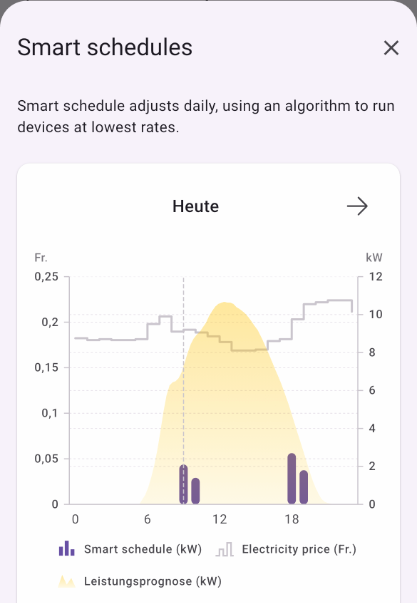
Forecast, plan, adjust
Shifting load is only worth something if the plan is right. Three layers do that work, and they are deliberately different kinds of technology.
Forecasting
Solar production, household load and day-ahead prices are all time-series problems. Zerofy runs its own forecasting models, built on recent domain-specific foundation-model approaches, to produce the inputs the plan depends on.
Planning
Deciding what runs when, under real constraints — the car has to be full by seven, the water has to be hot — is a classical optimisation problem, and that is what solves it. Not a language model.
Explaining
A plan that is right but opaque still feels wrong. Zerofy is building a conversational layer that answers why a device was scheduled when it was, and which forecast or price drove the decision.
Questions about load shifting
What is load shifting?
Moving electricity consumption from one time of day to another, without changing how much you use. Heating, hot water and car charging all have slack in them — they need to be finished by a certain time, but not at a particular minute. A home energy management system uses that slack to put the consumption into the cheapest, sunniest hours.
Does this mean I use less electricity?
No, and that is the point. You use the same kilowatt-hours, so nothing in the house has to be given up. What changes is what those kilowatt-hours cost, because you buy fewer of them at the expensive end of the day and use more of your own solar instead of exporting it.
Do I need a home battery?
No. A battery helps, and Zerofy will use one if you have it, but the biggest flexible loads in most homes are the heat pump and the car. A buffer tank and a well-insulated house already store hours of heat, and a car plugged in overnight is a battery that is going to be charged anyway.
Do I need a dynamic electricity tariff?
Not for solar optimisation — Solar mode simply lines your consumption up with your own production and works on any tariff. Price optimisation needs a tariff that actually varies by hour, such as one priced off EPEX SPOT or Nordpool. With both, the two effects stack.
What hardware do I have to install?
None, in most cases. Zerofy runs in the cloud and talks to inverters, chargers, heat pumps and meters through their manufacturers' own interfaces, so setting up is a matter of connecting accounts rather than wiring a box into the meter cabinet.
Which devices can Zerofy actually control?
Inverters and batteries, wallboxes and many cars directly, heat pumps over SG Ready or the manufacturer's API, air conditioning, water heaters, smart plugs and some appliances. The compatibility list is maintained per brand and per model, with what each integration can and cannot do.
How much does it save?
That depends on your devices, your tariff and your roof, so any single number would be made up. The levers are concrete, though: solar you use yourself is worth far more than solar you export, and on a dynamic tariff the cheapest and the most expensive hour of the same day often differ by a factor of three.
Will the house be colder, or the car not ready?
No. Comfort limits and deadlines are constraints the plan has to satisfy, not things it trades away — a departure time means the car is full by then, and a temperature limit is a floor, not a suggestion. If a cheap window does not fit inside your constraints, it does not get used.
New to the category? What is a home energy management system?
Put the day to work
Connect your inverter, your charger and your heat pump, pick Solar or Smart mode, and let Zerofy do the planning.