The energy transition runs on forecasts

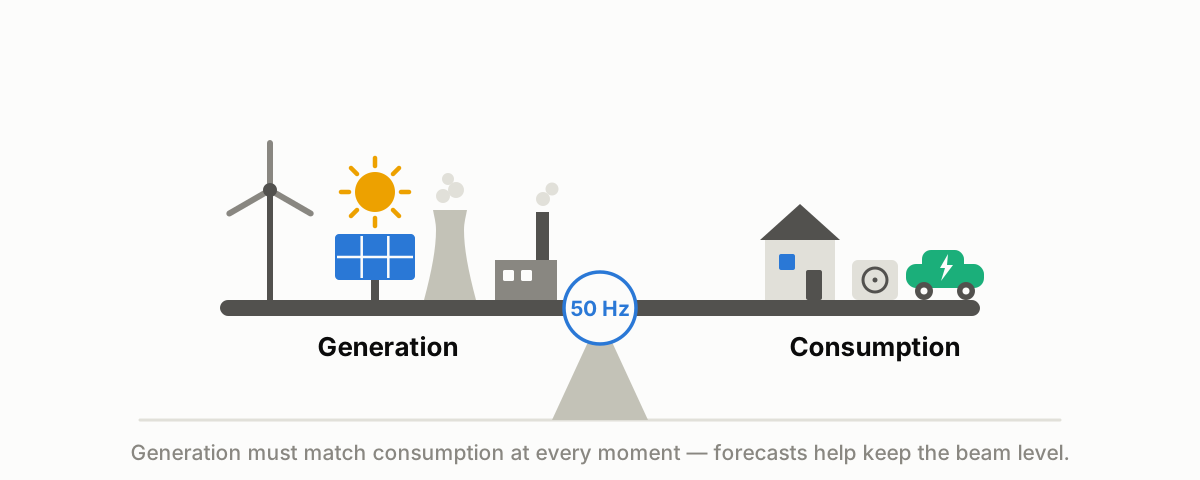
When you switch on a light, start a heat pump or plug in an electric car, the electricity must be produced at almost exactly the same moment.
The grid must continuously remain in balance: the amount of power entering it must closely match the amount being consumed. If generation and consumption diverge, the grid frequency changes and operators must react by adjusting power plants, storage, imports, exports or flexible demand.
If we could forecast electricity generation and consumption perfectly, operating the energy system would be much easier. Energy suppliers could buy exactly the right amount of electricity, grid operators would need very little balancing energy, and batteries and flexible devices could always be scheduled at the optimal time.
Perfect forecasting is impossible. Weather changes, people behave unpredictably and millions of devices continuously alter their operation. But every improvement in forecast accuracy reduces uncertainty, costs and unnecessary interventions.
That is why almost every part of the electricity system relies on forecasts.
Renewables and electrification increase uncertainty
Forecasting has always been important, but the energy transition makes it both more difficult and more valuable.
Solar and wind production depend heavily on the weather. A cloud front arriving earlier than expected can reduce solar output across an entire region. Wind generation can similarly rise or fall rapidly as conditions change.
Demand is also becoming more dynamic.
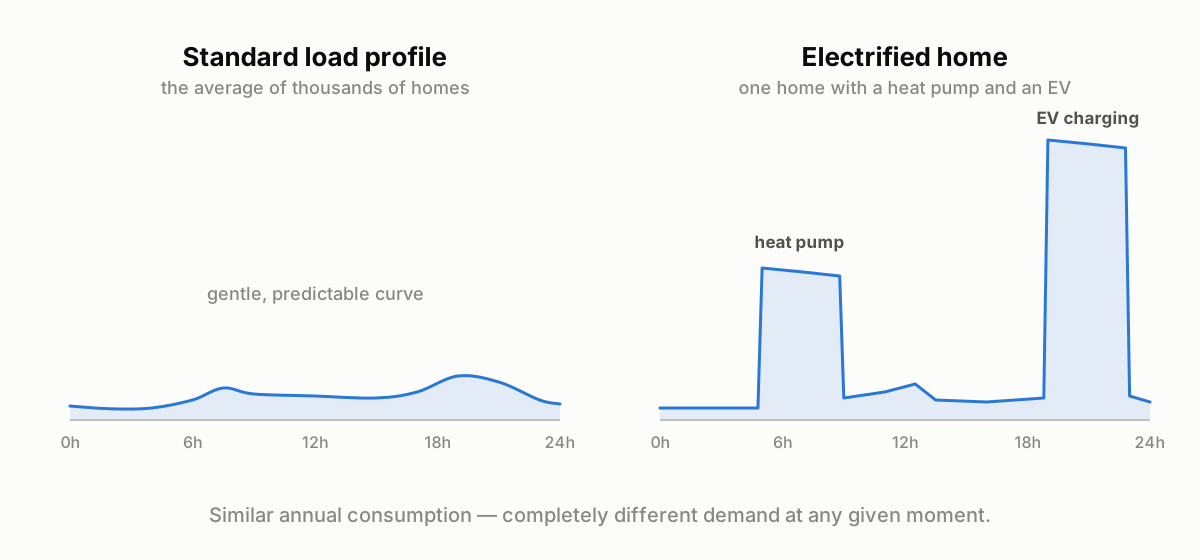
A traditional household mainly used electricity for lighting, cooking and appliances. An electrified home may also include an EV, heat pump, battery, air conditioning and electric hot-water system. Each of these can draw several kilowatts and substantially change the household’s demand.
Weather therefore affects both sides of the system. It determines renewable generation, but also heating and cooling demand. Other important factors include the time of day, weekdays, holidays, prices and individual household behaviour.
The International Energy Agency highlights variable solar and wind generation as well as increasingly concentrated demand from EVs, heat pumps and other large electrical loads as major drivers of future flexibility requirements.
Moving beyond the average household
Historically, residential electricity demand has often been estimated using standard load profiles.
A standard load profile describes the expected consumption pattern of a typical customer group. For example, the German BDEW household profile represents a typical daily and seasonal consumption curve in 15-minute intervals. The BDEW provides an explanation and the current profiles here.
These profiles can work reasonably well across thousands of conventional households because individual differences partly cancel each other out.
But they are much less useful for forecasting a specific home.
One household may charge an EV every evening. Another may operate a heat pump throughout a cold morning. A third may have solar panels and a battery. Their annual consumption may be similar, while their demand at any specific moment is completely different.
Traditional standard load profiles are therefore becoming less representative, especially for individual electrified homes. They remain useful as a baseline for large portfolios where better data is unavailable, but EVs and heat pumps introduce large loads that are strongly related to time, temperature and user behaviour.
Interestingly, BDEW itself updated its standard load profiles in 2025, noting that social and energy-system changes over the previous 25 years had altered consumption patterns.
Smart meters do not solve everything
Even where smart meters are installed, energy companies do not necessarily receive detailed data in real time.
Data may arrive with a delay, be held by another market participant or depend on local regulation, technical processes and customer consent. A smart meter also normally shows only the home’s net exchange with the grid.
It may show that a household imported five kilowatt-hours, but not whether this came from an EV, a heat pump or normal household consumption. It does not necessarily reveal the state of charge of a battery, when the car must be ready or how flexible the load is.
Having meter readings is therefore not the same as having the contextual data needed for accurate forecasting and optimisation.
The continuing introduction of more granular settlement systems illustrates this limitation. Ofgem explains that access to half-hourly smart-meter data has depended on settlement rules and consumer consent, while traditional profile classes estimate consumption using average customer behaviour.
Small errors can become large system errors
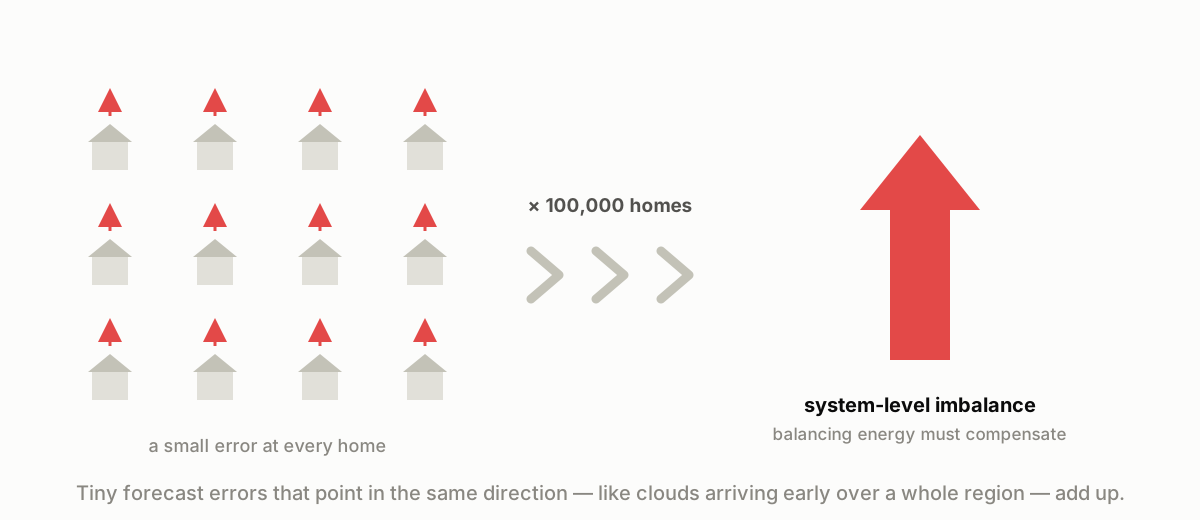
A forecast error at one household is irrelevant to the electricity system. The same error repeated across hundreds of thousands of homes can be significant.
Solar forecasting errors are particularly likely to move in the same direction across many installations. According to Swissgrid’s Balancing Roadmap, errors in photovoltaic production forecasts can create a high demand for balancing energy, and partially inaccurate PV forecasts contributed to higher Swiss balancing costs in 2024.
Snow, clouds and local weather effects make solar forecasting especially difficult. Satellite-based estimates can, under some conditions, confuse snow cover with clouds. A forecasting system therefore needs to understand not only the general weather forecast, but also how local conditions translate into actual production from real installations.
Better forecasting matters throughout the energy system.
Energy suppliers and balance-responsible parties use forecasts to buy the right amount of electricity and reduce imbalance costs.
Distribution system operators need to anticipate local peaks, such as many EVs charging on the same street or high solar exports through the same transformer.
Transmission system operators need to maintain the overall system balance and understand how much generation, demand and flexibility will be available.
The IEA notes that distributed resources such as rooftop solar, home batteries, EVs and smart appliances can help manage grid congestion, provided that the necessary communication, control and market structures are available.
Forecasting is at the heart of a HEMS
Forecasting is also one of the core capabilities of a modern Home Energy Management System.
To decide when a battery should charge, the system needs to estimate future household consumption, solar production and electricity prices.
To schedule an EV, it needs to know the expected household load, likely solar availability, the vehicle’s required state of charge and its departure time.
To control a heat pump, it needs to anticipate outdoor temperature, heating demand, prices and the thermal behaviour of the building.
Without forecasts, a HEMS can only react to what is happening now.
With good forecasts, it can prepare. It can charge a battery before an expensive period, delay a flexible load during a peak, retain energy for later or use solar production that would otherwise be exported.
Forecasting turns energy management from a collection of reactive rules into forward-looking optimisation.
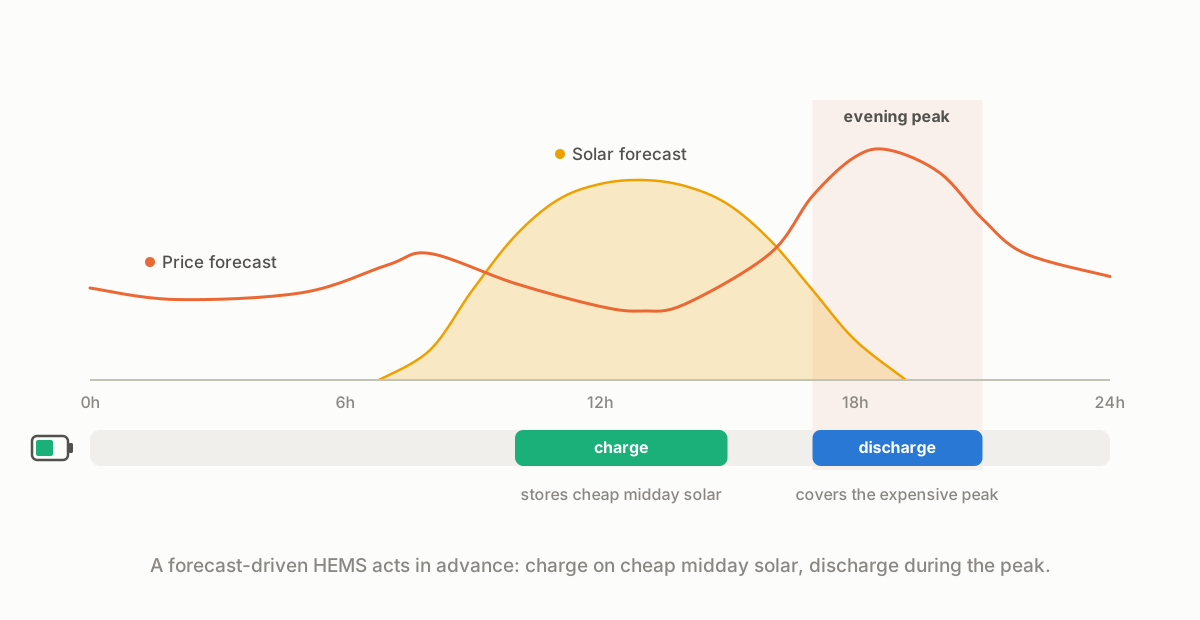
The same forecasts can also help the wider energy system. With the appropriate integrations and customer permissions, Zerofy can provide cooperating energy companies with forecasts of household consumption, solar generation and planned grid exchange.
Aggregated across many homes, these forecasts can improve energy procurement, help DSOs identify likely local constraints and allow aggregators or TSOs to understand how much flexible capacity may be available from batteries, EVs and heat pumps.
Better system forecasts improve optimisation inside the home. Better home-level forecasts improve the energy system’s view of future demand, generation and flexibility.
From statistical models to foundation models
Energy forecasting has traditionally used statistical methods such as exponential smoothing and ARIMA, as well as physical and machine-learning models.
These approaches identify recurring patterns, such as similar demand at the same time on previous weekdays or seasonal changes throughout the year. They remain useful, particularly for stable time series and smaller datasets.
More recent neural networks can learn more complex and nonlinear relationships across large datasets. The latest development is the emergence of time-series foundation models.
The idea is similar to large language models.
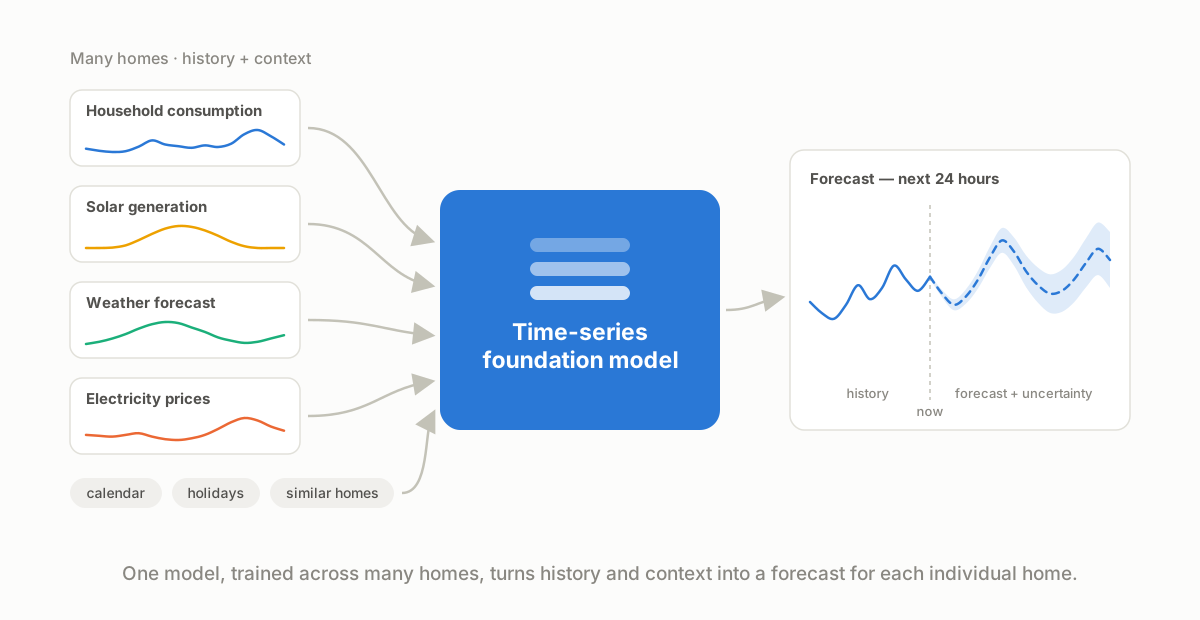
A language model learns reusable patterns from large amounts of text. A time-series foundation model learns reusable patterns from large collections of numerical sequences, including trends, cycles, repeated events and relationships across different time scales.
Google’s TimesFM, for example, was pretrained on 100 billion real-world time points and designed to forecast previously unseen time series. Amazon’s Chronos similarly adapts language-model architectures to numerical sequences.
Many early foundation models focused on univariate forecasting: predicting one variable mainly from its own history.
For example:
Based on this household’s past electricity consumption, what will it consume tomorrow?
For energy systems, forecasting becomes more powerful when the model can also use covariates: additional variables that influence the result.
These may include weather forecasts, time of day, holidays, electricity prices, device types and patterns observed in similar homes or nearby regions.
The weather input is itself a forecast. The model must learn how predicted temperature, sunshine or cloud cover translates into consumption or solar production for a particular building.
Newer foundation models are increasingly designed to combine univariate, multivariate and covariate-informed forecasting.
This also allows knowledge to be transferred between homes. A new household may have limited historical data, but the model can still learn from similar buildings, technologies and weather conditions elsewhere.
Our approach at Zerofy
At Zerofy, we have trained a time-series foundation model for residential energy forecasting. We train it from scratch using the structure and characteristics of residential energy data and relevant covariates.
It can forecast both sides of a household’s energy balance:
- household electricity consumption; and
- solar electricity generation.
These forecasts feed directly into Zerofy Autopilot and help determine how batteries, EVs, chargers, heat pumps and other flexible devices should operate over the coming hours.
In our evaluations, our approach outperformed the third-party forecasting system used as a comparison for more than 90% of the evaluated households.
No model can predict every cloud, human decision or device behaviour perfectly. The goal is not certainty.
The goal is to continuously reduce uncertainty, update forecasts as new information arrives and make better decisions as a result.
Solar panels, batteries, EVs and heat pumps are the visible technologies of the energy transition. Forecasting is the intelligence layer that allows them to work together.
Perfect forecasts would make the energy system easy. Better forecasts make it more efficient, affordable and resilient.